Choosing the best educational toys for your toddlers and preschoolers can feel overwhelming, especially with so many options available.
The word “educational” gets attached to almost everything these days, from plastic flashcard sets to elaborate electronic gadgets that beep and flash for ten minutes before losing your toddler’s interest entirely.
The reality is that the best educational toys for young children often look simpler than you’d expect, and the science behind why they work is more interesting than the packaging suggests.
This guide cuts through the noise. It covers what makes a toy truly educational at this age, breaks down the best options by age group and developmental skill, and gives you a practical reference you can actually use, whether you’re shopping for your own child, buying a gift, or looking to enrich your home learning environment.
You will also like
The Ultimate Baby and Toddler Care Guide for First time Parents: Everything You Need to Know from Birth to Age 3
How To Soothe A Colicky Baby Naturally
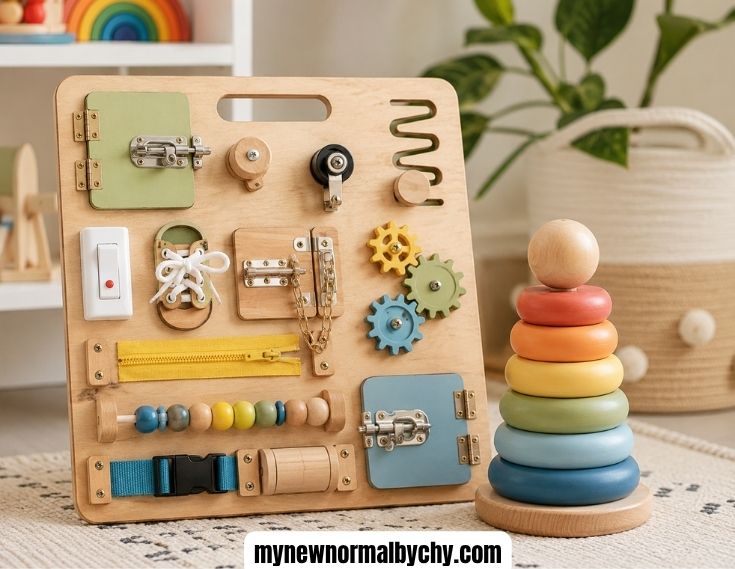
What Makes a Toy Truly Educational?
I think it’s worth understanding what educational actually means in the context of early childhood development, because it’s not about drill-and-practice flashcards or apps that teach letter sounds.
Research in early childhood education consistently points to play as the primary vehicle through which young children learn. The American Academy of Pediatrics describes play as “essential to the social, emotional, cognitive, and physical well-being of children.” That’s a significant statement, and it has real implications for what kinds of toys are worth investing in.
Genuinely educational toys for this age group tend to share a few common characteristics:
1. They’re open-ended
The toy can be used in multiple ways, encouraging creativity and problem-solving rather than following a single fixed instruction.
2. They develop a real skill
Whether it’s fine motor control, spatial reasoning, language, numeracy, or social-emotional understanding, the toy is building something measurable and meaningful.
3. They hold attention through intrinsic reward
The child keeps playing because the activity itself is engaging, not because the toy makes noise or lights up when a button is pressed.
4. They grow with the child
The best toys are ones that can be used differently at two years old than at four, extending their educational value across developmental stages.
With that framework in mind, here’s a breakdown by age and skill area.
You will also like
30 Fun Screen-Free Summer Activities For Busy Toddlers
25 Creative Sensory Activities For Toddlers And Preschoolers
Sensory Play Ideas For Toddlers With Autism
Educational Toys for Toddlers Ages 1 to 2
At this stage, children are learning primarily through their senses and their movement. They’re building object permanence, cause-and-effect understanding, early language, and the first stages of fine and gross motor skills. Toys at this stage should be safe, simple, and rich in sensory experience.
1. Shape Sorters and Stacking Rings
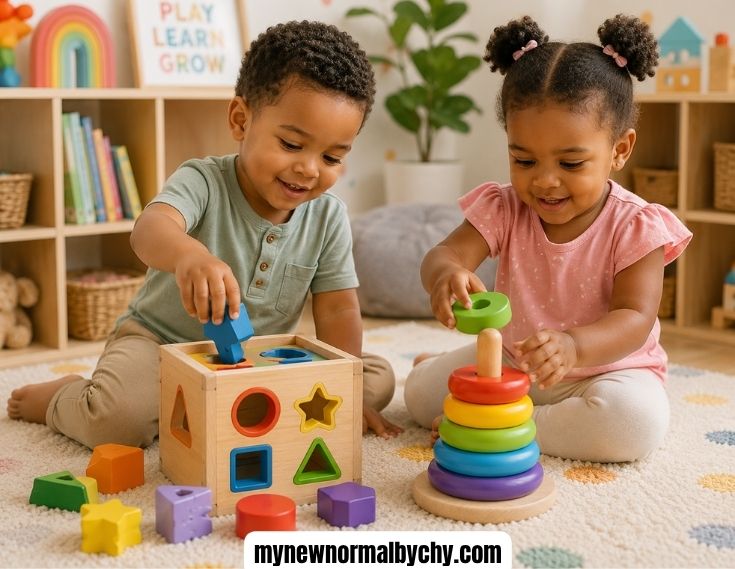
Classic for a reason. Shape sorters directly teach spatial reasoning, color and shape recognition, and the beginning of problem-solving, what happens when the square block doesn’t fit the circular hole. Stacking rings introduce size sequencing and hand-eye coordination in a satisfying, repeatable format.
When choosing, prioritize chunky pieces appropriate for small hands, bright contrasting colors, and a design that stays engaging even when the child is using it in unconventional ways (which they absolutely will).
You will also like
How To Prepare Your Toddler For A New Baby; Everything you Need To Know
Signs Your Toddler Is Ready For Potty Training
How To Reset A Toddler’s Sleep Schedule
2. Sensory Bins and Texture Sets
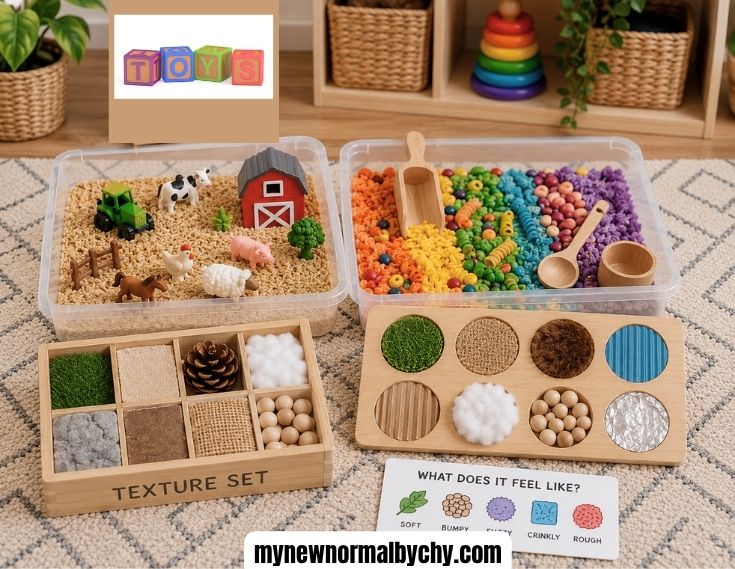
Sensory play, exploring different textures, temperatures, and materials, directly supports neurological development at this age. A simple bin filled with dried rice or lentils, or a set of textured tiles or balls, gives toddlers the sensory input their developing nervous system is actively seeking.
The best options are those with age-appropriate materials that pose no choking risk, are easy to clean, and offer enough variety to sustain interest across multiple play sessions.
3. Soft Building Blocks
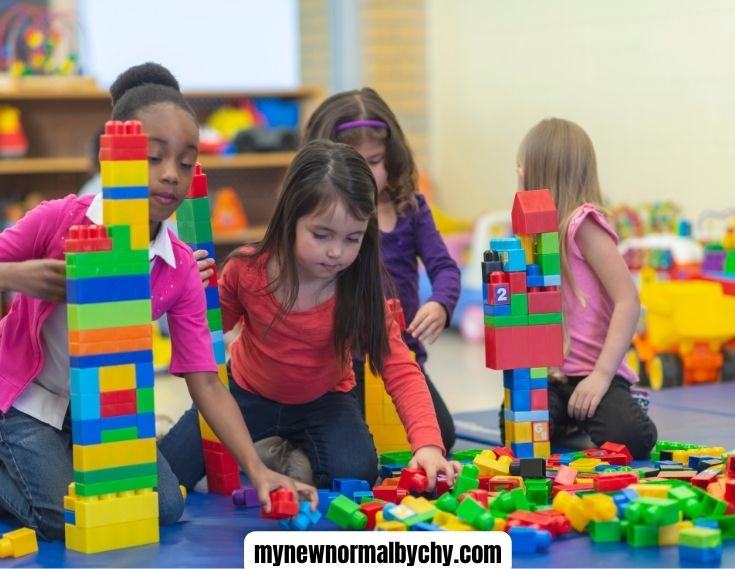
Large, lightweight building blocks introduce early engineering concepts — stacking, balancing, cause and effect (what happens when the tower falls), and spatial awareness.
They also support imaginative play as children begin to assign meaning to their constructions. Look for lightweight foam or fabric blocks in varied shapes, safe for falls, and large enough to stack without requiring fine precision.
4. Push and Pull Toys
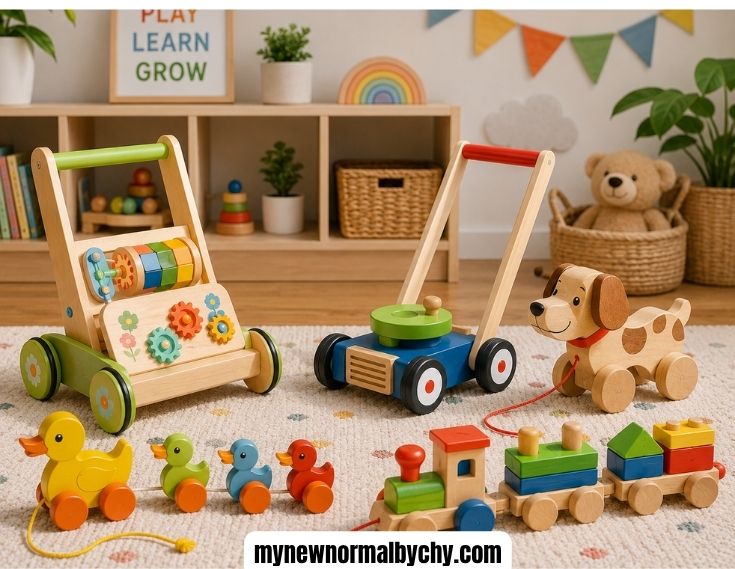
Toys that a toddler pushes or pulls while walking develop gross motor skills, balance, and spatial awareness. They also introduce early concepts of cause and effect (push the toy and it moves) and give a newly walking toddler a sense of control and accomplishment.
A stable design, smooth wheels, and a size proportional to your child’s current height and mobility are the details worth checking before buying.
You will also like
How To Prepare Toddlers For Their First Day Of School
20 Creative Backyard Play Areas For Kids On A budget
How To Encourage Healthy Eating Habits In Children
5. Simple Peg Puzzles
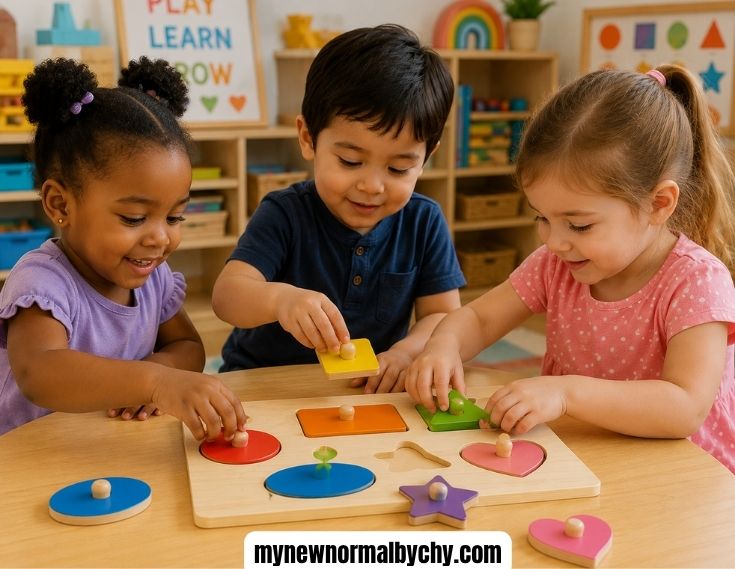
Chunky wooden peg puzzles with three to six pieces introduce early problem-solving, shape recognition, and fine motor development, specifically the pincer grasp used to pick up individual pieces.
Choose puzzles with real images (animals, vehicles, food) rather than abstract shapes, since recognizable imagery adds an extra layer of language-building opportunity every time your child names what they see.
Educational Toys for Toddlers Ages 2 to 3
By age two, children are rapidly expanding language, developing more complex pretend play, and beginning to show genuine interest in other children.
Toys at this stage should support language development, imaginative play, and the growing ability to follow sequences and simple rules.
You will also like
Common Baby Feeding Mistakes New Parents Make And How To Fix Them
Best First Foods For Babies Starting Solids
The Best Way To Stop Toddler Tantrums In Public
6. Duplo and Large Building Sets
Larger Lego Duplo sets or similar interlocking building toys are among the most genuinely educational toys available for this age group. They develop fine motor skills, spatial reasoning, creativity, and early engineering thinking, all simultaneously.
They’re also highly open-ended, which means the same set can be used very differently from month to month as your child’s skills grow.
The best options feature large, easy-to-connect pieces appropriate for small hands, a set size that won’t overwhelm, and a design that encourages open-ended building rather than following a single template.
7. Wooden Alphabet Puzzles and Magnetic Letters
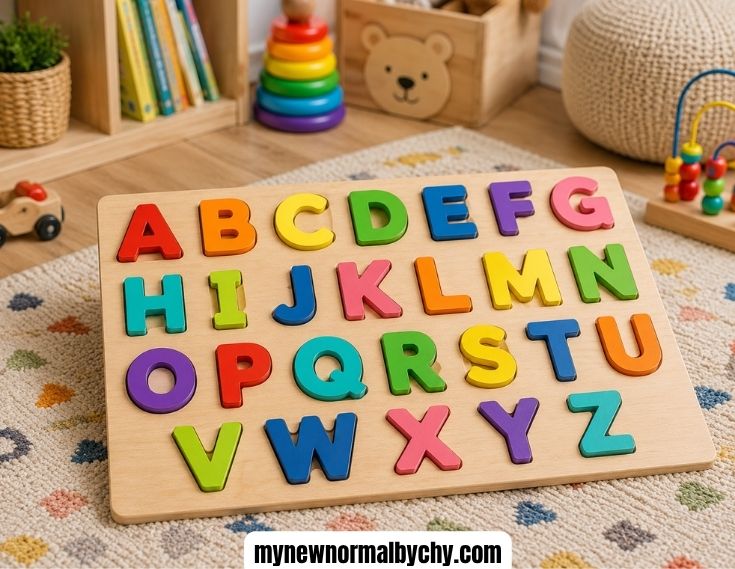
Early literacy begins long before reading, it begins with letter recognition, phonics awareness, and learning that written symbols carry meaning.
Wooden alphabet puzzles and fridge magnet letters make these concepts tangible and playful rather than rote or pressured. Opt for chunky pieces with clear, clean letterforms, both upper and lowercase options for variety, and designs that make individual letters satisfying to handle, that tactile pleasure matters more than it might seem.
8. Pretend Play Sets
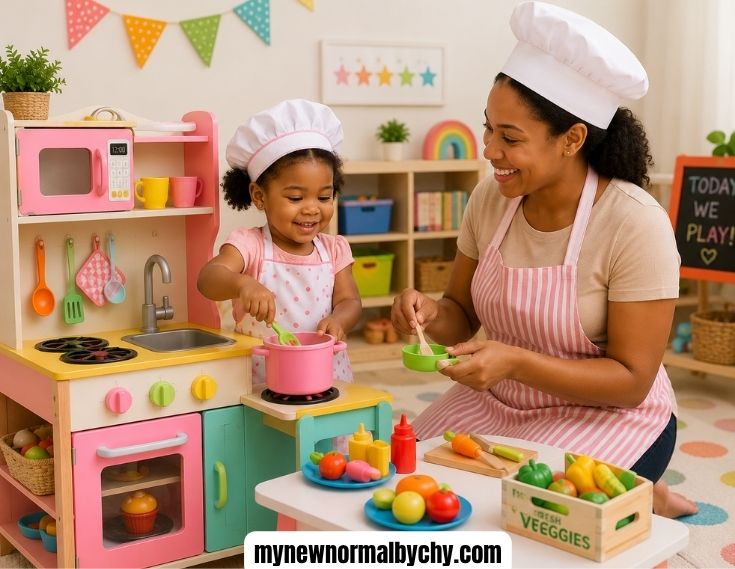
A play kitchen, a doctor’s kit, a simple toolset, or a set of play food introduces imaginative play, one of the most cognitively complex activities young children engage in.
Pretend play develops language (narrating what they’re doing), social-emotional understanding (taking on roles and perspectives), and early abstract thinking.
The best sets are realistic enough to spark imagination, simple enough for a child to use independently, and durable enough to withstand enthusiastic two-year-old play.
9. Simple Matching and Memory Games
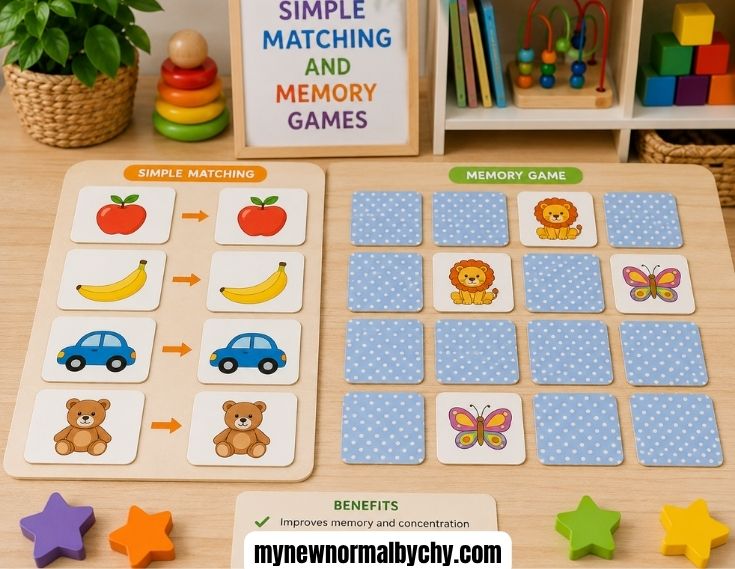
Age-appropriate matching games, picture cards turned face-down, matched in pairs, introduce working memory, concentration, and the beginning of turn-taking and rule-following.
Start with very small sets (four to six pairs) and expand as your child’s working memory develops. Simple, clear images and cards that are easy for small hands to turn over and hold will serve you far better than more elaborate options at this stage.
10. Beginner Jigsaw Puzzles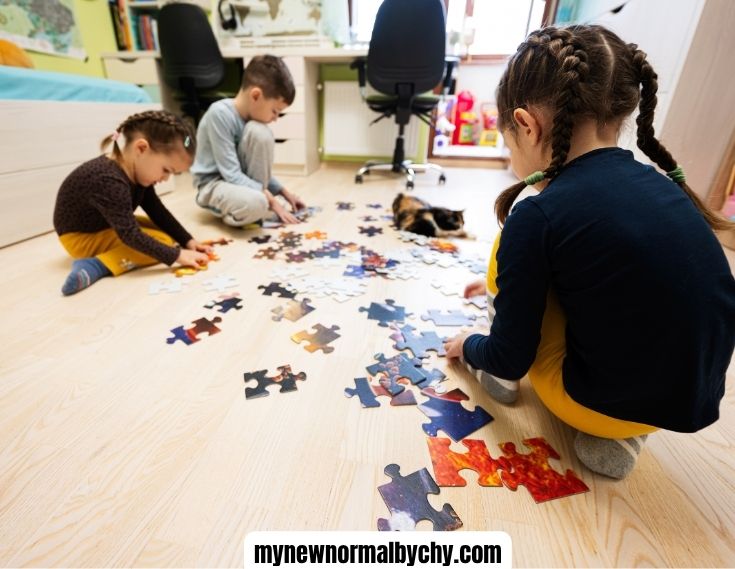
Moving from peg puzzles to simple four to eight-piece jigsaw puzzles is a meaningful developmental step that requires spatial reasoning, persistence, and problem-solving.
The satisfaction of completing a puzzle also builds confidence and a growth mindset around challenges. Large pieces, vivid images, and a box that keeps pieces organized without losing any make all the difference in whether this becomes a daily activity or a frustrating experience.
You will also like
Gentle Parenting Strategies To Handling Toddler Tantrums
Baby Nursery Closet Organisation Ideas For Small Spaces
Water Play Summer Activities For Toddlers
Educational Toys for Preschoolers Ages 3 to 5
At this stage, children are developing more sophisticated cognitive skills, early numeracy, phonics awareness, logical sequencing, and complex social play.
The best toys for this age group challenge children just enough to require effort, while remaining accessible enough to be genuinely fun.
11. STEM Building and Magnetic Tile Sets
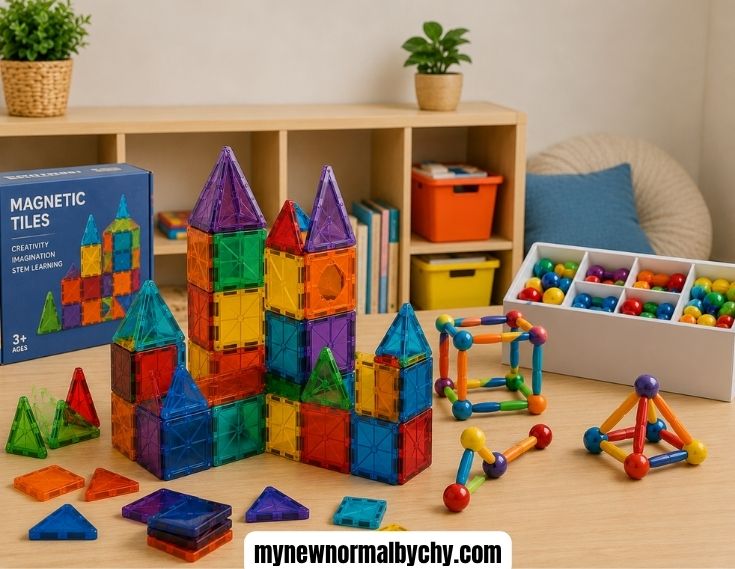
Magnetic tile sets (such as Magna-Tiles or similar alternatives) are among the most highly regarded educational toys for this age group, and consistently recommended by early childhood educators.
They develop spatial reasoning, geometry awareness, engineering thinking, and creativity simultaneously — and children can use the same set very differently at three versus five.
When choosing, strong magnets, stable construction, a range of shapes, and a size large enough to build with meaningfully are the qualities worth prioritizing.
12. Science Kits Designed for Preschoolers
Simple, hands-on science kits introduce early scientific thinking, observation, prediction, and cause-and-effect reasoning, in a format that feels like play.
Volcano kits, simple nature observation sets, and basic experiment boxes all count here. The ones that hold attention longest tend to have age-appropriate safety, clear instructions, reusable materials where possible, and activities that encourage the child to predict and observe rather than simply follow steps passively.
13. Coding and Sequencing Games
Early coding toys, like Osmo, Code-a-Pillar, or simple sequencing card games, introduce computational thinking at an age-appropriate level.
These toys teach children to plan sequences of actions, recognize patterns, and debug simple problems, all without a screen (or with very limited screen interaction).
Genuinely unplugged or screen-minimal designs that allow for multiple attempts and revisions tend to deliver the most sustained value at this age.
14. Board Games With Simple Rules
Cooperative board games for young children (where players work together rather than competing) develop social-emotional skills, turn-taking, rule-following, and the ability to handle both winning and losing gracefully.
Games like Hoot Owl Hoot, Zingo, or Snail’s Pace Race are well-designed for this developmental stage, simple, visually clear rules, a playing time short enough to hold a preschooler’s attention, and a cooperative structure that keeps the atmosphere collaborative rather than competitive.
15. Art and Craft Supplies as Educational Tools
Open-ended art, drawing, painting, cutting, tearing, and sticking — develops fine motor skills, creativity, self-expression, and planning skills simultaneously.
A well-stocked, accessible art station at home is genuinely one of the most educational investments you can make for a preschooler. Age-appropriate, non-toxic materials set up within easy reach, with enough variety to suit different creative moods on different days, is really all it takes.
Number and Math Manipulatives
Counting bears, abacuses, number tiles, and simple math manipulatives make early numeracy concepts concrete and physical rather than abstract.
Children at this age understand numbers far better when they can touch, move, and sort them than when they’re learning from a worksheet.
Bright, distinct colors for sorting, a quantity large enough to count meaningfully, and a design that lends itself to multiple activities beyond counting alone are what separate a genuinely useful set from a decorative one.
A Note on Screen-Based Educational Toys
This is a topic worth addressing directly, because the market is full of tablets, apps, and interactive screens marketed as educational tools for toddlers and preschoolers.
Current guidance from the American Academy of Pediatrics recommends limiting screen use for children under 18 months (other than video chatting), and suggests that screen time for children aged 2 to 5 should be limited to one hour per day of high-quality programming.
The reason isn’t that screens are inherently harmful, but that passive screen time displaces the hands-on, language-rich, socially interactive play that most meaningfully supports early development.
This doesn’t mean all screen-based learning tools are without value, but it does mean that for this age group, open-ended, physical, hands-on play consistently outperforms screens in research on developmental outcomes.
When you’re choosing between a screen-based option and a physical one, the physical option is almost always the stronger choice for children under five.
How to Choose the Right Educational Toy
With so many options available, a few simple guiding questions can help narrow any decision:
1. Does it fit my child’s current developmental stage, and does it offer a little stretch? The most engaging toys tend to sit slightly above your child’s current comfort zone, offering enough challenge to require effort without becoming frustrating.
2. Is it open-ended, or does it have one fixed use? Toys with multiple ways to be used almost always deliver more lasting educational value than toys designed for a single activity.
3. Does my child return to it? Repeated, sustained engagement is the single best indicator that a toy is genuinely hitting the right developmental note for your child at this moment.
4. Is it safe for my child’s age and developmental stage? No toy’s educational value outweighs safety concerns. Always check age recommendations, material safety, and choking hazard warnings.
5. Does it complement rather than replace human interaction? The most educational experiences at this age almost always involve an adult or another child alongside the toy — talking, narrating, co-constructing. The best toys invite this kind of interaction naturally.
Practical Tips for Getting the Most Out of Educational Toys
Rotate toys regularly. Keeping all toys available all the time often reduces the value of each one. Rotating a selection in and out of play keeps toys feeling fresh and extends their engagement over time.
Less is more. Research on children’s play environments suggests that having too many toys available at once can actually reduce the quality of play. A curated selection of toys that genuinely serve your child’s current developmental needs tends to produce deeper, more focused engagement than a room full of options.
Play alongside your child. Your presence, language, and engagement alongside a toy significantly amplifies its educational value. Even a few minutes of sitting alongside your child and narrating what you both see adds language, social connection, and meaning to what might otherwise be solitary play.
Allow for open-ended exploration. Resist the urge to show your child the “correct” way to use every toy. Children often extract unexpected educational value from toys when left to explore them independently — and the process of figuring things out is often more valuable than the end result.
Frequently Asked Questions
Q: What is the most important thing to look for in an educational toy for a toddler?
The most important factor is whether the toy genuinely engages your child’s own thinking, asking them to problem-solve, create, explore, or imagine, rather than simply entertaining them passively. Open-ended, hands-on toys that invite repeated and varied use tend to deliver the most sustained educational value.
Q: Are Montessori toys worth it?
Montessori-aligned toys, typically made from natural materials, designed for independent use, and focused on real-world skills, align well with what research shows about effective learning in early childhood.
You don’t need to follow a strict Montessori approach to benefit from these principles; the core idea of providing children with materials that are beautiful, purposeful, and slightly challenging is broadly applicable and well-supported.
Q: At what age should I introduce STEM toys?
Simple STEM concepts can be introduced from very early, shape sorters and building blocks at one year old are introducing early spatial and engineering thinking.
More intentional STEM toys with science kits and coding concepts become more appropriate from around age three, when children can follow multi-step sequences and engage with cause-and-effect thinking more explicitly.
Q: How many toys does a toddler actually need?
Far fewer than most homes contain. Research suggests that a smaller, curated selection of high-quality, developmentally appropriate toys produces better-quality play than a large quantity of varied options.
If you had to choose, quality and variety of toy type (building, art, pretend, puzzle) matters more than total quantity.
Q: How do I know if a toy is actually educational or just marketed that way?
Ask whether the toy requires active engagement from the child (thinking, creating, problem-solving) or passive engagement (watching, pressing buttons).
Educational toys generally invite the child to do something, to build, sort, create, or figure out, rather than simply receiving stimulus from the toy. If the toy does all the work, it’s likely more entertainment than education.
Q: What are the best educational toys that the whole family can use together?
Board games designed for mixed ages (like Zingo, Spot It Junior, or Hoot Owl Hoot), building sets that everyone can add to, and simple art materials are all activities that work well across a family age range.
Cooperative games in particular are an excellent choice for mixed-age family play, since they reduce the competitive element that can create frustration for younger children.
Final Thoughts
The best educational toy for your toddler or preschooler isn’t necessarily the most expensive, the most technologically advanced, or the one with the longest list of claimed benefits on the packaging.
It’s the one that meets your child where they are developmentally, challenges them just enough to stay interesting, and invites them to be the active agent in their own learning.
A set of magnetic tiles, a wooden alphabet puzzle, a simple puzzle, or a well-stocked art station will almost always outperform the flashiest gadget on the shelf, not because simple is better for its own sake, but because children at this age learn best through doing, touching, building, and imagining.
Trust the process, follow your child’s lead, and look for the toy they keep coming back to. That’s the one that’s doing its job.
Leave a Reply