Gentle parenting strategies for handling toddler tantrums is not a myth. Trust me, it is practicable and works effectively.
Toddler tantrums are one of the most emotionally demanding phases of early childhood development. They can appear suddenly, escalate quickly, and feel disproportionate to the situation from an adult perspective. However, from a developmental standpoint, tantrums are not random misbehavior, they are predictable outcomes of an underdeveloped emotional regulation system interacting with rapidly growing cognitive and social awareness.
Between ages 1 and 4, a child’s brain is undergoing significant neural development, particularly in the prefrontal cortex (responsible for impulse control, planning, and emotional regulation). At the same time, the limbic system (which processes emotion) is highly active. This imbalance means toddlers feel emotions intensely but lack the neurological capacity to regulate them independently.
Gentle parenting approaches this reality not as a discipline problem, but as a developmental coaching opportunity. Rather than suppressing emotional expression through fear or punishment, it prioritizes co-regulation, communication, and long-term emotional skill-building.
This guide provides a structured, practical, and real-world framework for managing toddler tantrums using gentle parenting principles both at home and in public spaces, while also strengthening emotional resilience over time.
Gentle Parenting Strategies for Handling Toddler Tantrums

What Gentle Parenting Really Means in Tantrum Situations
Gentle parenting is frequently mis- characterized as permissiveness or lack of boundaries. In reality, it is a highly structured, emotionally intelligent approach that combines empathy with firm limits.
In the context of tantrums, gentle parenting is defined by four core operational principles:
- Emotional acknowledgment without validation of harmful behavior
- Firm, consistent boundaries communicated without aggression
- Adult emotional regulation as the stabilizing anchor
- Skill-building rather than punishment-based compliance
It is important to distinguish between emotional acceptance and behavioral acceptance.
A child’s feelings are always valid in experience, but not all behaviors resulting from those feelings are acceptable (e.g., hitting, throwing objects, or screaming in unsafe environments).
Gentle parenting operates on the assumption that behavior change is most sustainable when the child develops internal regulation rather than external fear-based compliance.
Check out our
30 Fun Screen-Free Summer Activities for Busy Toddlers
15 Water Play Summer Activities for Toddlers
The Best Sensory Play Ideas for Rainy Days
Gentle Parenting Strategies for Handling Toddler Tantrums

1. Start With Emotional Validation
The first intervention in a tantrum is not correction, it is emotional attunement.
When a toddler is in a heightened emotional state, their nervous system is dominated by the limbic response (fight, flight, or freeze). In this state, language processing and logical reasoning are significantly reduced. This is why reasoning such as “calm down” or “it’s not a big deal” is neurologically ineffective in the moment.
Instead, validation functions as a de-escalation mechanism by signaling safety.
Ineffective responses:
- “Stop crying immediately.”
- “You’re being dramatic.”
- “There’s nothing to cry about.”
Effective responses:
- “I can see you’re very upset.”
- “You really wanted that, and it feels frustrating.”
- “This is hard for you right now.”
Validation does not reinforce the tantrum; it reduces perceived threat and helps the child transition from emotional flooding toward regulation.
In developmental continuity terms, children who had earlier soothing experiences, such as caregivers learning how to soothe a colicky baby naturally, often respond more quickly to validation because their nervous system has been repeatedly co-regulated from infancy.
2. Stay Calm Even When They Are Not

Co-regulation is one of the most critical mechanisms in gentle parenting. Toddlers do not yet possess self-regulation skills; instead, they borrow regulation from caregivers.
This means the adult’s emotional state directly influences the child’s escalation trajectory.
If the caregiver becomes louder, faster, or visibly frustrated, the child’s nervous system often mirrors and amplifies that intensity. Conversely, calm presence acts as a stabilizing external regulator.
Practical regulation techniques for caregivers:
- Lower vocal tone instead of raising it
- Slow down speech deliberately
- Maintain relaxed but attentive body posture
- Control breathing rhythm (slow nasal breathing is particularly effective)
- Avoid rapid gesturing or sudden movements
This is especially relevant in public environments where external pressure is high, as discussed in best ways to stop toddler tantrums in public, where environmental stimulation and social attention can intensify caregiver stress.
The goal is not emotional suppression in the caregiver, but emotional containment, remaining steady enough to anchor the child’s dysregulated state.
3. Set Clear and Consistent Boundaries
Gentle parenting does not eliminate discipline; it reframes discipline as structured guidance rather than punitive correction.
Boundaries must meet three criteria to be effective:
- Clarity – the child understands what is allowed and what is not
- Consistency – rules do not change based on emotional intensity
- Calm delivery – boundaries are stated without threat or hostility
Examples:
Instead of:
- “Stop this or I will punish you!”
Use:
- “I will not allow hitting.”
- “We are not buying that today.”
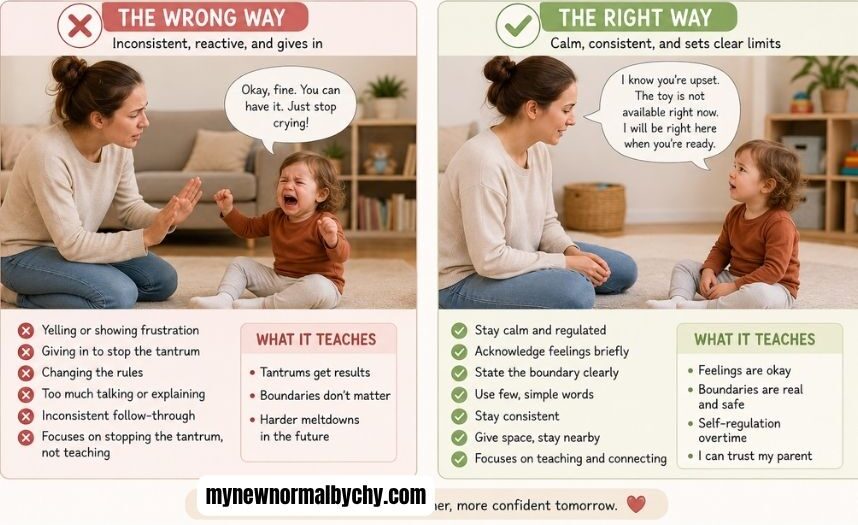
The difference lies in tone, predictability, and emotional neutrality.
Children feel safer when limits are stable. Paradoxically, consistent boundaries reduce tantrum frequency over time because unpredictability is one of the major triggers of emotional dysregulation.
4. Offer Limited Choices to Restore Control
A central driver of toddler tantrums is perceived loss of control. At this developmental stage, children are building autonomy but have very limited actual agency.
Offering structured choices restores a sense of control without removing adult authority.
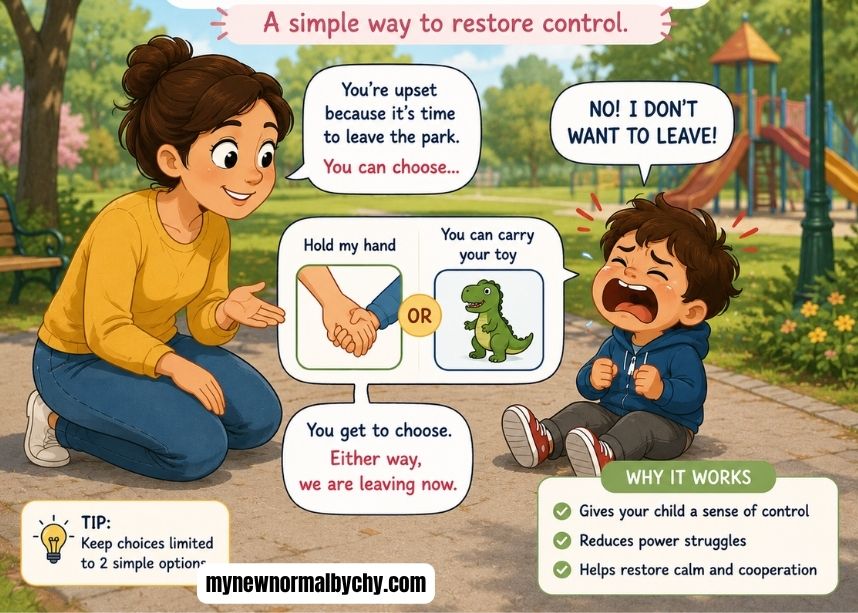
Effective choice structures:
- “Do you want to walk or be carried?”
- “Do you want the red cup or the blue cup?”
- “Do you want to put your shoes on yourself or should I help you?”
These are not open-ended decisions; they are constrained options within acceptable boundaries.
This technique is particularly effective in behavioral domains like feeding and routines, aligning with principles used in how to encourage healthy eating habits in toddlers, where controlled autonomy reduces resistance and power struggles.
5. Avoid Power Struggles
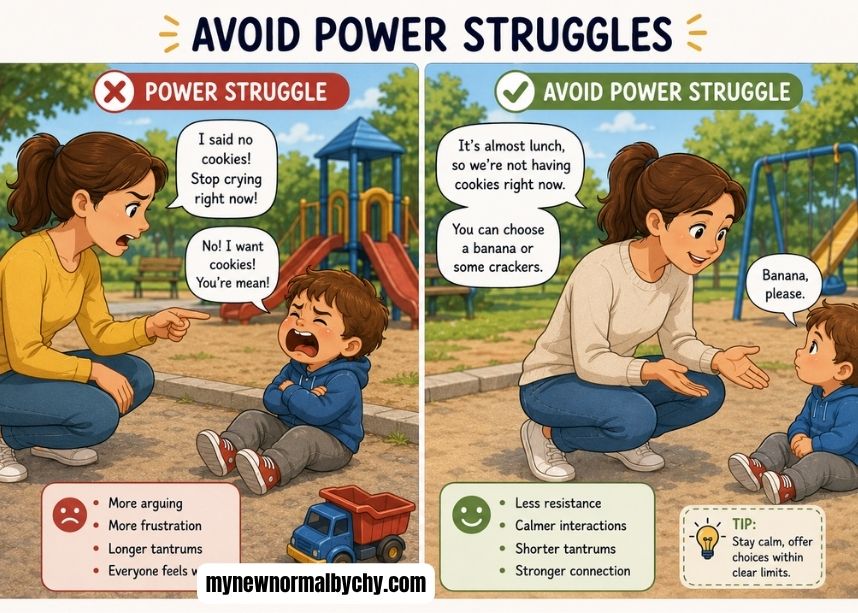
Tantrums often escalate when caregivers unintentionally enter a control negotiation with the child. However, during emotional dysregulation, toddlers lack the neurological capacity for negotiation or compromise.
Power struggles typically manifest when:
- The adult repeats instructions multiple times
- The adult attempts to force immediate compliance
- The adult responds to resistance with increased pressure
Gentle parenting replaces this dynamic with timing-based intervention:
- During escalation: regulate and contain
- During calm: teach and redirect
The key principle is that instruction without regulation is ineffective.
6. Use Connection Before Correction
Behavioral correction is only effective when relational connection is intact. Without connection, correction is perceived as threat rather than guidance.
Before addressing behavior:
- Move physically closer if appropriate
- Get to eye level
- Use calm, steady tone
- Offer comfort if the child is receptive
Once the child’s nervous system has stabilized, cognitive processing returns and learning becomes possible.
This principle is consistent across developmental stages, including infancy feeding transitions and routines such as those discussed in best first foods for babies starting solids and common baby feeding mistakes new parents make, where emotional safety directly influences behavioral cooperation.
7. Help Name Their Emotions
Emotional labeling is a foundational tool in building emotional intelligence. Toddlers often experience overwhelming internal states without the vocabulary to interpret them.
By naming emotions, caregivers help build neural associations between feeling states and language.
Examples:
- “You feel angry.”
- “You feel disappointed.”
- “You feel frustrated because we had to leave.”
Over time, this supports the development of emotional granularity, the ability to distinguish between similar emotional states, which is strongly correlated with improved self-regulation later in childhood.
8. Teach After the Tantrum, Not During
One of the most common errors in toddler discipline is attempting to teach during emotional escalation. During a tantrum, the child’s cognitive processing capacity is significantly reduced.
Key neurological limitations during tantrums:
- Reduced working memory
- Impaired language processing
- Limited attention span
- Dominance of emotional brain systems
Effective teaching must occur after regulation is restored. Post-tantrum reflection should be brief and simple:
- “You were very upset earlier.”
- “We don’t hit when we are angry.”
- “Next time, you can tell me you’re upset.”
The goal is integration, not interrogation.
9. Create a Predictable Environment


Predictability is a core regulatory factor in early childhood behavior. Toddlers rely heavily on environmental cues to anticipate transitions and outcomes.
High-impact structure strategies include:
- Consistent sleep and meal routines
- Advance warnings before transitions (“5 more minutes, then we leave”)
- Visual or verbal schedules
- Repeated daily patterns
Unpredictability increases cognitive load, which often manifests as irritability, resistance, or emotional outbursts.
10. Understand Triggers From Early Development
Toddler behavior is often shaped by earlier developmental experiences. Emotional regulation patterns begin forming in infancy and continue evolving through early childhood.
Examples of developmental continuity:
- Infants with colic may develop heightened sensory sensitivity
- Early feeding struggles may influence later food resistance
- Inconsistent soothing responses may affect attachment security and emotional stability
This is why understanding early-stage caregiving, including topics like how to soothe a colicky baby naturally, provides valuable insight into later behavioral patterns.
11. Use Gentle Redirection Instead of Force
Redirection is a preventive de-escalation strategy that shifts attention rather than confronting behavior directly.
Instead of:
- “Stop doing that!”
Try:
- “Let’s go look at this instead.”
- “Can you help me with this?”
- “Come see something interesting here.”
This works by interrupting escalation cycles without triggering defensive resistance.
12. Know When to Pause and Step Away
In some cases, the most effective intervention is temporary disengagement (while maintaining safety).
Stepping away is appropriate when:
- Emotional escalation is intense and prolonged
- The caregiver is also becoming dysregulated
- No immediate safety risk is present
This is not abandonment; it is emotional reset strategy. A regulated caregiver is more effective than an overwhelmed one.
13. Build Emotional Skills Outside Tantrum Moments
Long-term reduction in tantrum frequency is not achieved during tantrums, it is achieved in calm periods.
Daily emotional skill-building includes:
- Discussing feelings during neutral moments
- Reading emotionally themed storybooks
- Modeling calm responses to frustration
- Practicing patience in small, low-stakes situations
Over time, these micro-interventions build emotional literacy and resilience, reducing both intensity and duration of future tantrums.
Linking Gentle Parenting to Broader Developmental Stages
Toddler behavior is not isolated; it is part of a developmental continuum that begins in infancy and extends into later childhood.
For example:
- Feeding behavior reflects early nutritional and emotional associations
- Emotional regulation reflects early soothing patterns
- Routine acceptance reflects caregiver consistency in infancy
Relevant related topics include:
- Signs Your Toddler Is Ready For Potty Training
- How To Prepare Your Toddler For A New Baby: Everything You Need To Know
- How to soothe a colicky baby naturally
- Best ways to stop toddler tantrums in public
- How to encourage healthy eating habits in toddlers
- Common baby feeding mistakes new parents make
- Baby Nursery Closet Organisation Ideas for Small Spaces
- The Best Sensory Play Ideas For Rainy Days
- How To Set Up A Small Backyard Play Area For Toddlers
- 20 Creative Backyard Play Areas for Kids On A Budget
Each stage builds foundational neural and behavioral patterns that influence later outcomes.
My Final Thoughts On Gentle Parenting Strategies for Handling Toddler Tantrums
Gentle parenting is not a technique designed for instant compliance; it is a developmental framework for raising emotionally competent children.
Toddler tantrums are not failures of discipline, they are expressions of an immature but rapidly developing emotional system. When caregivers respond with consistency, emotional regulation, and structured boundaries, children gradually internalize these patterns.
The long-term outcome is not simply fewer tantrums, but improved emotional intelligence, stronger self-regulation, and healthier relational skills.
FAQs
1. Is gentle parenting effective for severe tantrums?
Yes, but effectiveness depends on consistency, caregiver regulation, and long-term application rather than immediate results.
2. Does gentle parenting eliminate discipline?
No. It reframes discipline as structured guidance with emotional respect and consistent boundaries.
3. How long do toddler tantrums usually last?
Typically between 2–15 minutes, though duration varies based on triggers and caregiver response.
4. Why do toddlers tantrum more with primary caregivers?
Because they feel safest with primary caregivers and therefore express emotions more freely.
5. Can gentle parenting reduce tantrums over time?
Yes. With consistent co-regulation and boundary-setting, tantrums typically reduce in frequency, intensity, and duration.
Leave a Reply