
Have you ever said “my book,” “your phone,” or “Sarah’s bag”? If yes, good news, you already use possessives! You just didn’t know they had a name. Today, we’ll learn the name, the rules, and how to use them with confidence every time.
Let’s go through this together, step by step. No rushing, no pressure, just clear explanations and plenty of practice.
What Are Possessives? (The Simple Meaning)
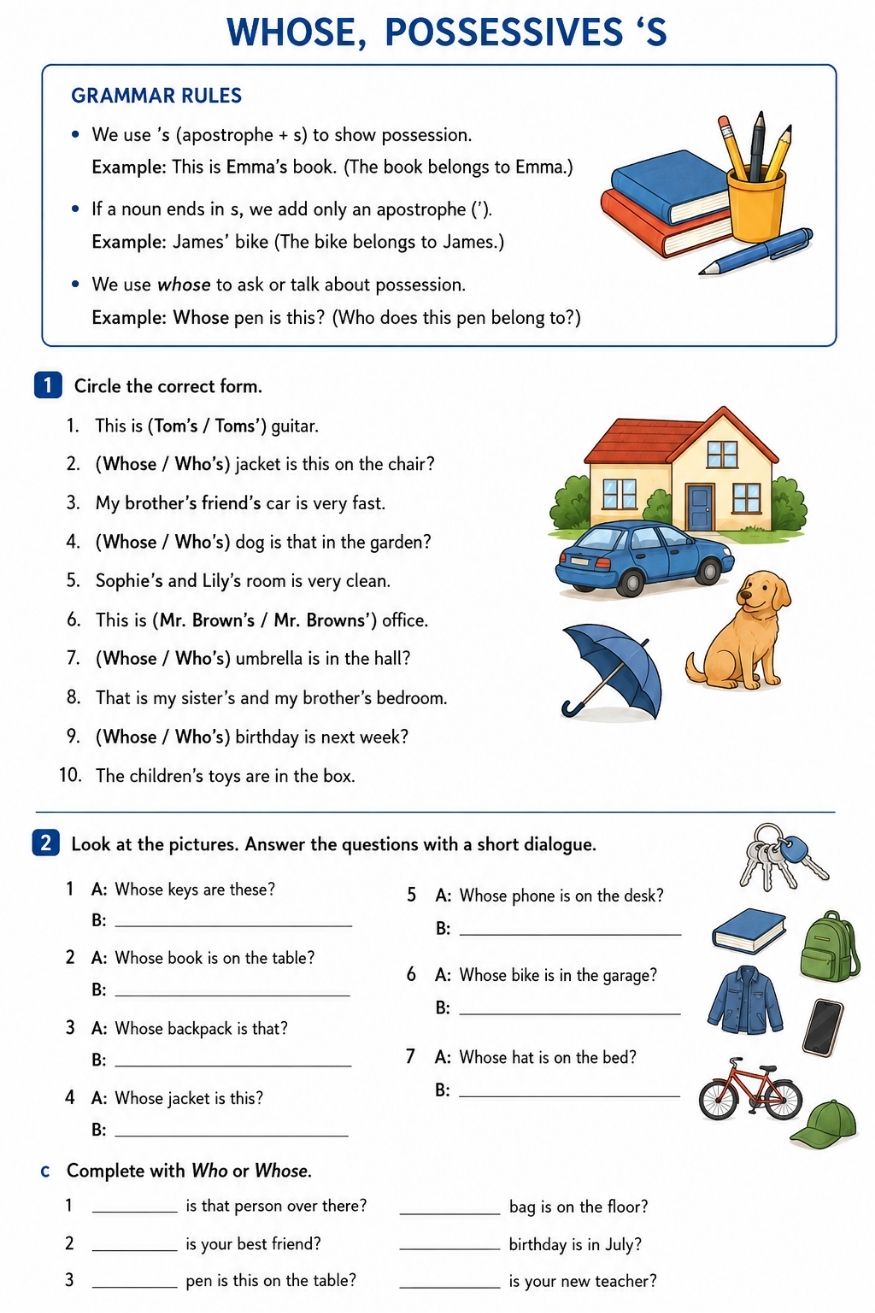
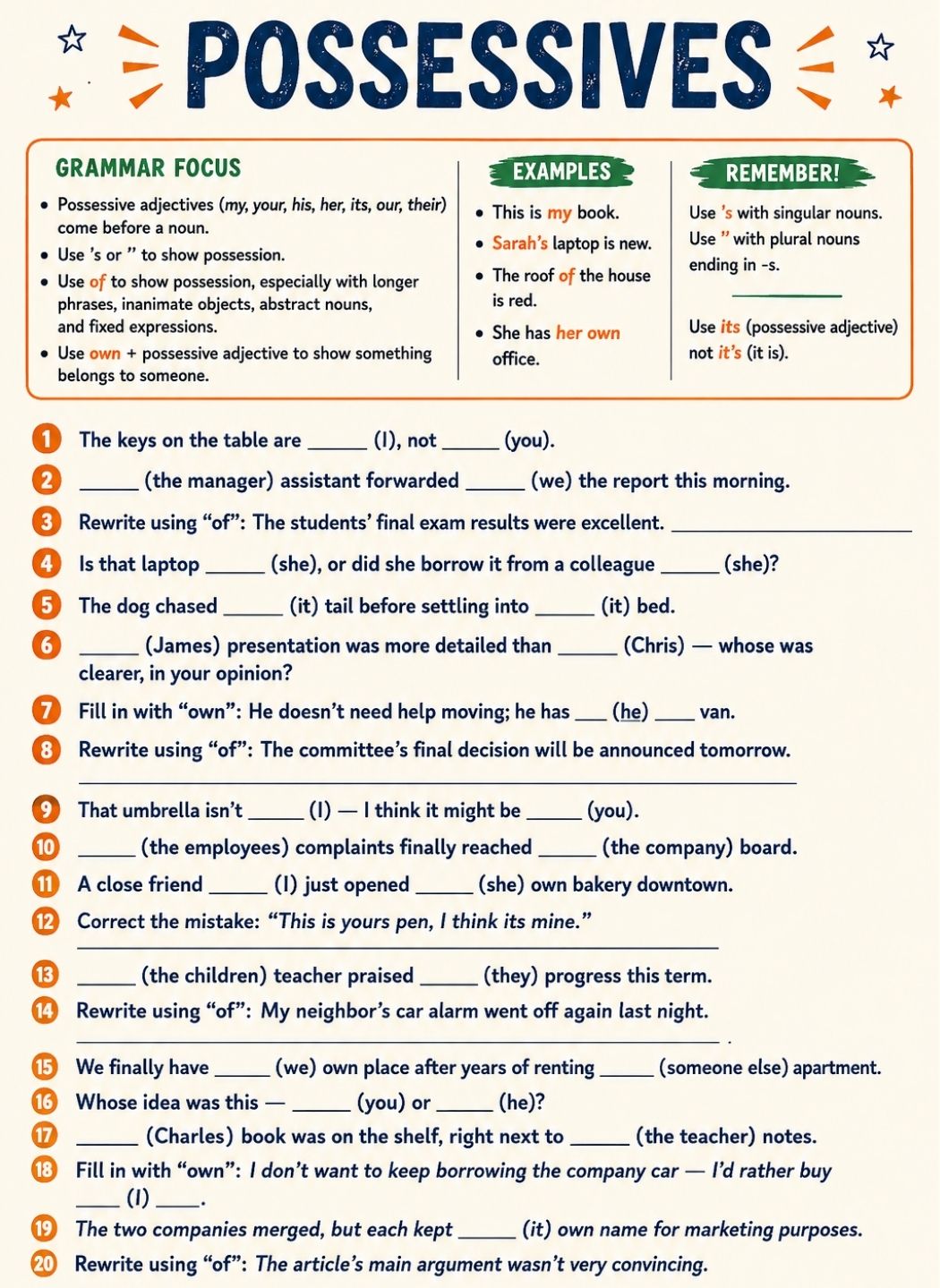
Possessives are words we use to show that something belongs to someone or something.
Think about something you own right now, maybe your phone. The phone belongs to you. So you would say: “This is my phone.”
“My” is a possessive word. It tells us who the phone belongs to — you.
Possessives answer one simple question: Whose is it?
- Whose book is this? → It is my book.
- Whose dog is that? → That is her dog.
- Whose car is this? → This is John’s car.
Every time you answer “whose,” you are using a possessive. It’s a small concept, but it shows up constantly, at work, at home, in conversation with friends, almost everywhere.
10 Easy Phonics Practice For Busy Parents (That Actually Works)
Present Simple Affirmative And Negative
The Two Types of Possessives
In English, there are two main ways to show possession. Let’s look at both.
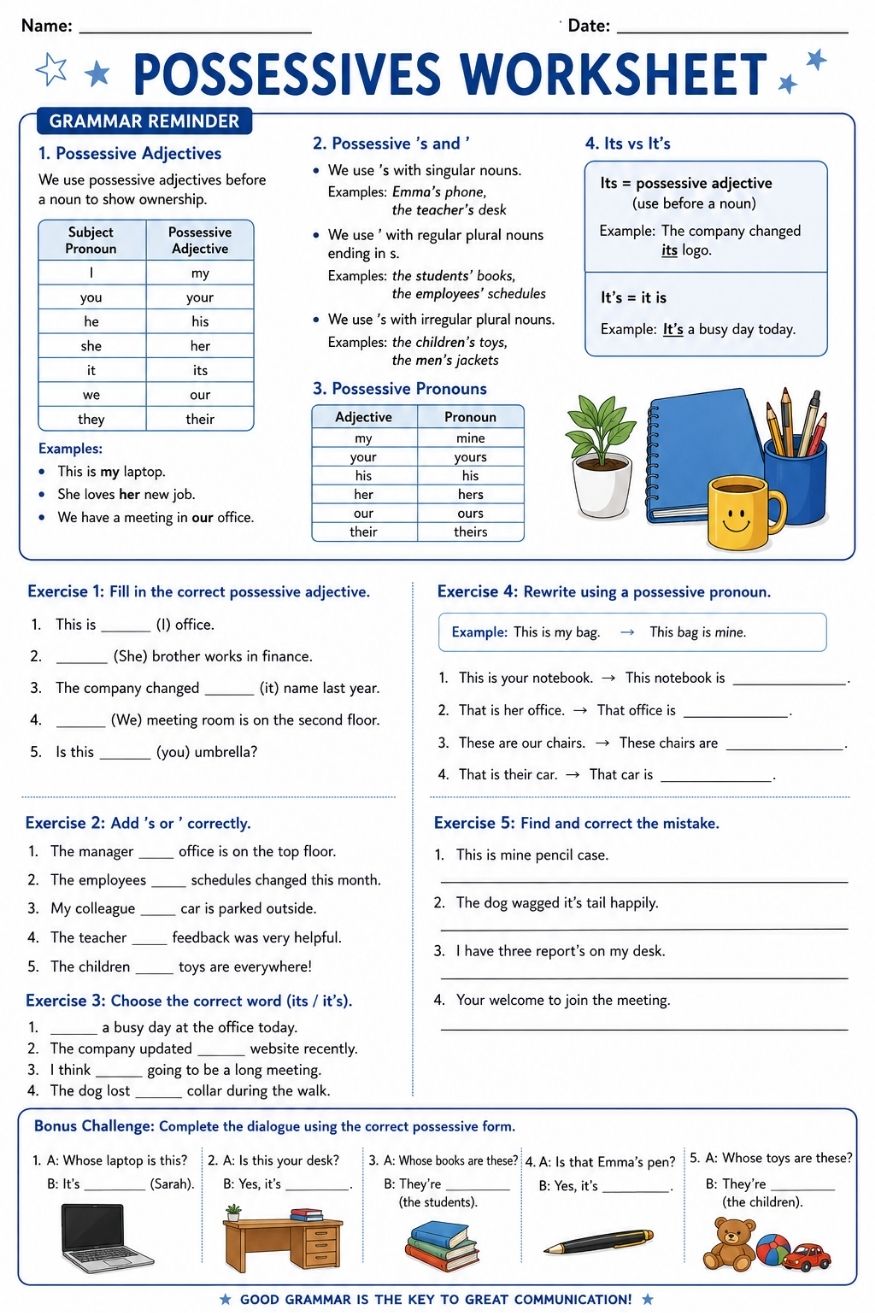
1. Possessive Adjectives
These words come before a noun and tell us who owns it.
| Subject | Possessive Adjective | Example |
|---|---|---|
| I | my | This is my laptop. |
| You | your | Is this your umbrella? |
| He | his | His office is upstairs. |
| She | her | Her car is in the garage. |
| It | its | The company changed its logo. |
| We | our | Our meeting is at 3 p.m. |
| They | their | Their flight was delayed. |
Notice that possessive adjectives always sit directly in front of a noun. You wouldn’t say “This is my.” You’d say “This is my laptop.” The possessive adjective and the noun stay together — they’re a package deal.
2. Possessive Nouns (Using an Apostrophe + S)
When we want to show that a person, animal, or thing owns something, we usually add ‘s to the end of the noun.
- Maria’s car (the car belongs to Maria)
- The dog’s leash (the leash belongs to the dog)
- My manager’s office (the office belongs to my manager)
The pattern is simple:
Noun + ‘s + the thing they own
If Tom owns a house, we say: Tom’s house. If your colleague has a desk, we say: My colleague’s desk.
You will also like
Present Simple Vs Continuous For Easy Practice
Creative Phonics Activities To Help Kids Love Reading
10 Fun Phonics Games Kids Can Play At Home
What If the Noun Is Plural?
Good question, and one worth slowing down for.
When a noun is plural and already ends in “s,” we just add an apostrophe after the s, no extra s needed.
- The employees’ parking lot (a lot for many employees)
- My parents’ house (the house belongs to my parents)
- The teachers’ lounge (a room for many teachers)
But if the plural noun does not end in s (like “children” or “men”), we still add ‘s as usual:
- The children’s toys
- The men’s department
What About Names That Already End in S?
Here’s another situation worth knowing, especially since it comes up often with people’s names. When a singular name already ends in “s”, like James, Charles, or Chris, you have two acceptable options:
- Add just an apostrophe: James’ car
- Add ‘s: James’s car
Both are considered correct in modern English, and you’ll see native speakers use either one. Many style guides now prefer adding the ‘s (James’s car), so that’s a safe default if you’re not sure which to choose.
As for pronunciation, when you add ‘s to a name ending in s, you pronounce it as an extra syllable, “James’s” is said as “James-ez.” If you choose to write it as just “James’,” it’s still usually pronounced the same way in speech, even though the spelling doesn’t show the extra “ez” sound.
A few more examples to get comfortable with:
- Chris’s backpack (said as “Chris-ez backpack”)
- Charles’s office (said as “Charles-ez office”)
English has a habit of throwing in small exceptions like this, but with a bit of practice, it becomes second nature.
Using a Name Alone to Mean Someone’s House
In casual, everyday English, we sometimes use a possessive name by itself to mean “that person’s home.” You’ll hear this a lot in spoken conversation.
- “We’re meeting at Sarah’s tonight.” (meaning: at Sarah’s house)
- “I left my charger at John’s.” (meaning: at John’s place)
- “Are you coming to my parents’ for dinner?” (meaning: to my parents’ house)
Notice that the noun for “house” or “place” simply disappears — we don’t need to say it, because everyone understands it from context. This is very common in spoken English and informal writing, so it’s useful to recognize even if you don’t use it right away yourself.
Check out our
Lovely DIY Teacher Gift Ideas From Students
25 Affordable Gift Ideas For End Of The Year
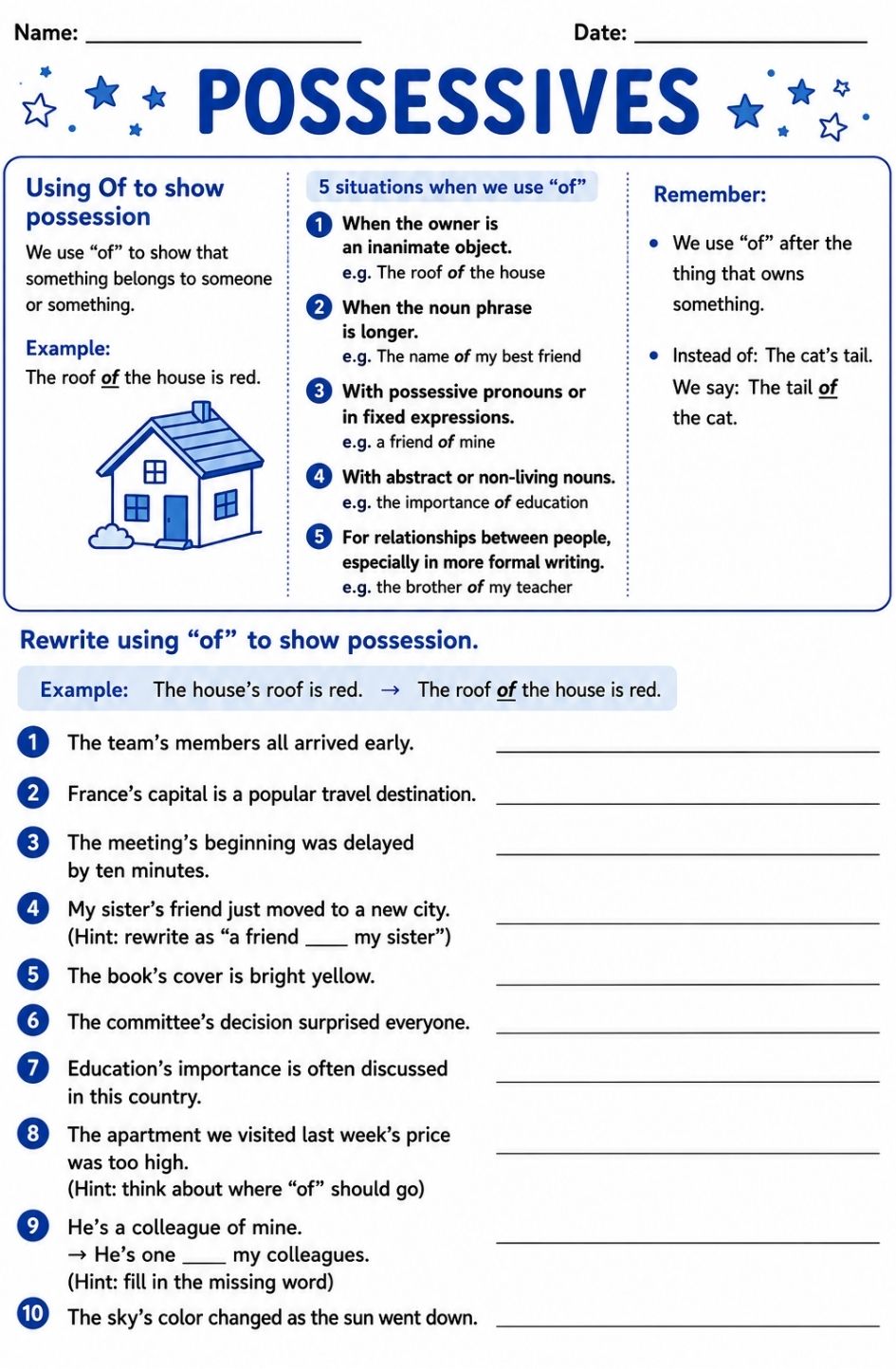
Showing Possession with “Of”
Besides ‘s and possessive adjectives, English also uses the word “of” to show possession. This isn’t a separate topic to memorize from scratch, it’s simply another tool that fits certain situations better than ‘s does. Let’s look at exactly when to reach for it.
1. When the “owner” is a thing or place, not a person
When the possessor is an object, building, or place rather than a person, “of” often sounds more natural than adding ‘s.
- The roof of the house (rather than “the house’s roof”)
- The capital of France
- The cover of the book
2. When the noun phrase is long or has extra description
If the owner is described with several words rather than a short name, “of” keeps the sentence from feeling clumsy.
- The opinion of the woman sitting next to me
- The decision of the committee that reviewed the application
- The price of the apartment we looked at last week
Trying to force ‘s onto a long phrase like this (“the woman sitting next to me’s opinion”) sounds awkward in English — “of” solves that problem.
3. With possessive pronouns, in fixed expressions
“Of” regularly pairs with possessive pronouns (mine, yours, his, hers, ours, theirs) in expressions that describe one item among many that belong to someone.
- A friend of mine (one of my friends)
- A colleague of hers (one of her colleagues)
- A habit of his (one of his habits)
Notice the meaning here is slightly different from a simple possessive. “A friend of mine” suggests one friend among several, while “my friend” can sound more direct or specific.
4. To show what something is made of, part of, or contains
“Of” is also used to show what something consists of or belongs to as a group or category — a slightly different but related use of possession.
- A cup of coffee
- A piece of cake
- The members of the team
5. With abstract or non-living nouns
When talking about qualities, ideas, or non-living things owning a feature, “of” is often the more natural and even only choice.
- The importance of education
- The beginning of the meeting
- The color of the sky
We wouldn’t naturally say “education’s importance” or “the sky’s color” in most everyday speech — “of” fits much more comfortably here.
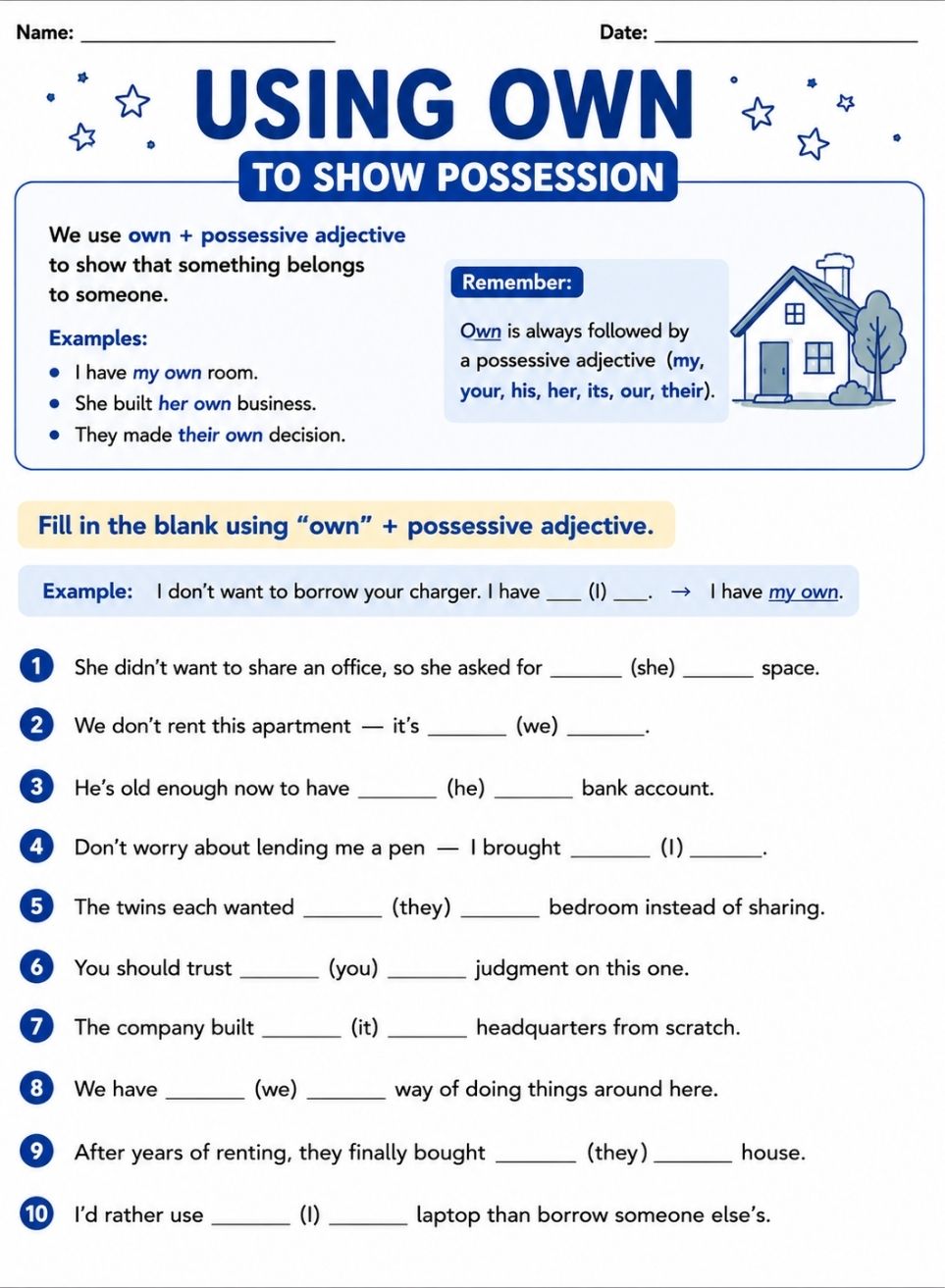
Showing Possession with “Own”
We use “own” to emphasize that something belongs to a specific person and not to anyone else. It usually follows a possessive adjective (my, your, his, her, our, their).
- This is my own laptop. (not borrowed, not shared — truly mine)
- She wants to start her own business.
- They have their own apartment now.
“Own” adds emphasis and is especially useful when you want to highlight independence or ownership clearly — for example, distinguishing between something shared and something personal.
- We share a printer at work, but I also have my own printer at home.
Quick Comparison: My vs. Mine, Your vs. Yours
This is where many adult learners get tripped up, so let’s slow down here too.
Possessive adjectives (my, your, his, her, our, their) always come before a noun. Possessive pronouns (mine, yours, his, hers, ours, theirs) stand alone — no noun needed after them.
Look at the difference:
- This is my report. ✅ (possessive adjective + noun)
- This report is mine. ✅ (possessive pronoun, alone)
- This is mine report. ❌ (incorrect — never place a noun after “mine”)
Common Mistakes Learners Make (And How to Fix Them)
Having taught possessives many times, I see the same handful of mistakes again and again, and they’re completely normal. Let’s go through them so you know exactly what to watch for.
Mistake 1: Confusing “its” and “it’s”
This is one of the most common mix-ups, even among advanced speakers and native English speakers.
- its = possessive (shows ownership) → The company updated its policy.
- it’s = it is or it has → It’s a busy week at work.
Mistake 2: Adding ‘s to plural nouns that don’t need it
Some learners write: “I have two laptop’s.” This is incorrect. The apostrophe is not used to make a word plural — it’s only used to show possession.
- ❌ I have two laptop’s.
- ✅ I have two laptops.
- ✅ This is my laptop’s charger. (correct — the charger belongs to the laptop)
Mistake 3: Forgetting the noun after possessive adjectives
Remember, possessive adjectives need a noun directly after them.
- ❌ This is mine pen.
- ✅ This is my pen.
- ✅ This pen is mine.
Mistake 4: Mixing up “your” and “you’re”
- your = possessive → Is this your jacket?
- you’re = you are → You’re doing great with this.
This mix-up is extremely common — even native speakers make this mistake regularly, so if you’ve made it too, you’re in good company.
Mistake 5: Putting the apostrophe in the wrong place for plurals
- ❌ The employee’s lounge (when referring to many employees) should be the employees’ lounge
- ✅ One employee’s desk (correct — one employee)
- ✅ The employees’ lounge (correct — many employees)
A Final Word
Possessives might feel like a lot of small rules at first, but here’s something worth noticing: you probably already use most of them correctly when you talk about your own life, your family, your job, your home, your daily routine. Every time you mention these things, you’re practicing possessives without even realizing it.
So here’s a small challenge for this week: pay attention to every time you say “my,” “your,” “his,” “her,” or someone’s name followed by ‘s. You’ll likely notice it happens more often than you’d think, and that you already know more than you give yourself credit for.
See you in our next lesson!
Looking for more clear, practical English grammar lessons ? Browse our other beginner-friendly posts designed to help you build real confidence in English.